
Explore educational mortgage resources from NorthStar Funding. These materials can help you prepare questions before a financing conversation; they are not a commitment to lend or a guarantee of approval.
Start with the resource that fits your question
- Compare mortgage loan options
- Explore mortgage calculators
- Review the mortgage glossary
- Read frequently asked questions
- Browse mortgage articles
For a specific scenario
Loan options, documentation, property review, and terms are evaluated for the full loan file. Contact NorthStar Funding to discuss your next questions.
Could a reverse mortgage fit your plans?
Watch NorthStar Funding’s 2½-minute introduction to HECM reverse mortgages: possible benefits, costs, homeowner responsibilities, repayment and alternatives. This is education, not a loan offer or a determination of eligibility.
English audio with English and Spanish subtitles. Use the player’s CC and Settings controls. Audio en inglés; subtítulos en inglés y español disponibles en CC y Configuración.
Watch the NorthStar Funding reverse-mortgage video on YouTube. English and Spanish captions are available. You can also read the transcript below.
Ask NorthStar Funding about your reverse-mortgage questions — compare the costs, obligations and alternatives before deciding.
Read the video transcript
If your home holds much of your savings, a reverse mortgage may be worth understanding. The most common type is a Home Equity Conversion Mortgage, or HECM. It is insured by the Federal Housing Administration and is for eligible homeowners age sixty-two or older.
It turns some equity into borrowed funds. Any existing mortgage must be paid off at closing. Using proceeds for that payoff may free up monthly cash flow, but leaves less for other needs.
You keep ownership. No monthly principal-and-interest payments are required while you meet the loan’s requirements. You still pay taxes, insurance and applicable association charges, maintain the home, and meet occupancy requirements. Missing obligations can put the home at risk.
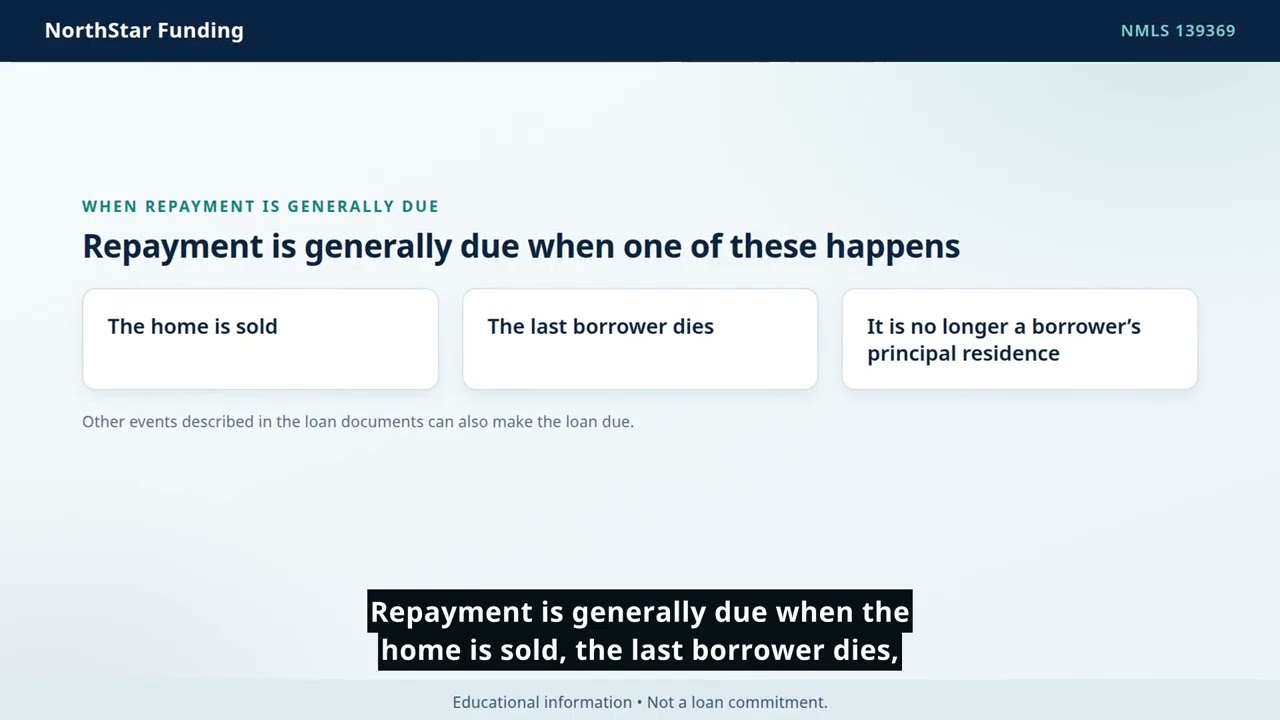
Interest and fees increase the debt and use equity. Repayment is generally due when the home is sold, the last borrower dies, or it is no longer a borrower’s principal residence. An eligible non-borrowing spouse may qualify to delay repayment under specific conditions. Discuss protections and your heirs’ plans before borrowing.
Imagine a homeowner who plans to stay for years and can afford ongoing housing costs. Funds may help with expenses or repairs. Someone moving soon, or unable to cover those costs, may need another approach.
Compare assistance, downsizing, refinancing or a home-equity loan. Those loans usually require monthly payments and qualification. HECM counseling and financial review are required. If you receive SSI or Medicaid, ask how holding proceeds could affect benefits.
A HUD-approved counselor can help you compare the choices with your budget and plans. You deserve a clear explanation before deciding.
Read our reverse-mortgage guide and the CFPB’s independent educational resources.